1.
Earlier this summer I started reading Henry David Thoreau’s Walden. Recently, I have found solace and space for growth by immersing myself in nature and in fine writing; Walden combines both at the highest levels.
One of the most quoted passages of Walden explains why the book resonates with me now, as it has done for so many other readers:
I went to the woods because I wished to live deliberately, to front only the essential facts of life, and see if I could not learn what it had to teach, and not, when I came to die, discover that I had not lived.
To be deliberate, to open oneself to what life has to teach, to assess whether or not one has even lived–what could be more worthy?
Admittedly, one might criticize different aspects of how Thoreau responded to this goal of “living deliberately”–certainly his project depended on the considerable privileges available to him as a white man in nineteenth century New England. Nonetheless he made a real go of it, building a house in the woods and living alone in it for over two years in his attempt to engage “only the essential facts of life.”
Walden is also a book about a time of grieving, as his move to the cabin was preceded by the death of his brother, and the losses of numerous close friends, including children. In grief, we are forced to dwell on what matters, as what does not suddenly recedes from our awareness. Thoreau’s famous admonition to “Simplify, simplify, simplify!” reflects such a perspective. Grieving helps Thoreau cut out what does not matter–wasteful self-expression (e.g., gossip and most communications in general, including the post office!) and wasteful acquisition (e.g., needless furniture, tools, and property). He pursues, and shows us how to pursue, only what is essential to living.
2.
While there are various outcomes to this search in Thoreau, I’d summarize them to say that he presents himself during the two years at Walden as a certain kind of subject–what today we might be inclined to see as, if not a posthuman subject, then at least the precursor to one.
This subject integrates seemingly disparate elements into an “organic” whole: he is a scientific chronicler of the sounds and behaviors of flora and fauna, a profound reader of the classics, an epic hoer of beans and a moonlight fisherman, a maker and an up-cycler, a land surveyor, and a protester arrested for refusing to pay taxes to a government that enslaves.
The imperative to “simplify!” means to strip away what is unnecessary, unhealthy; but it does not mean to strip away complexity. Rather it means that the remaining complexity all somehow hangs together.
3.
Thoreau is also an exceptional writer, as shown in this passage in which he describes Walden Pond:
it impressed me like a tarn high up on the side of a mountain, its bottom far above the surface of other lakes, and, as the sun rose, I saw it throwing off its nightly clothing of the mist, and here and there, by degrees, its soft ripples or its smooth reflecting surface was revealed, while the mists, like ghosts, were stealthily withdrawing in every direction into the woods, as at the breaking up of some nocturnal conventicle.
I believe that Thoreau’s literary sensibilities are well served by his capacity for careful scientific observation, that is, that empirical observation of the natural world and the humanistic quality of fine expression–far from hailing from “two cultures“–are united in Thoreau. In the above quote, his attention to the movement of the mists over water is metaphorically ghostly and furtive, the ritual of a forbidden religion.
In that unity of nature and literature, the natural world comes alive in as art (it is, in Haraway’s parlance, “natureculture“). For example, he writes,
you could fancy [the hooting owl to make] the most melancholy sound in nature, as if [it were] the dying moans of a human being–some poor weak relic of mortality who has left hope behind, and howls like an animal, yet with human sobs, on entering the dark valley, made more awful by a certain gurgling melodiousness [that is] expressive of a mind which has reached the gelatinous, mildewy stage in the mortification of all healthy and courageous thought. […] But now [another owl] answers from far woods in a strain made really melodious by distance–Hoo hoo hoo, hoorer hoo; and indeed for the most part [the answer] suggested only pleasing associations.
Wow. His description captures the sound itself (the hoo-hooing), the exact time of day it typically occurs (not included in the quote), a literary characterization of how the owl sound is expressive of melancholy, how it makes him feel, and the differences in tonality between nearby vs. distant owls. Abandoning hope and entering the dark valley are references to Dante’s Inferno, which chronicles its poet’s descent into Hell, so Thoreau’s description of the sound is not merely acoustic, but rather accesses one of the West’s most haunting expressions ever written about melancholy, and I’d argue Thoreau originally contributes to it, simultaneously enriching our conceptual vocabulary and connecting us vibrantly to nature.
4.
Amidst all of this, my mind made a curious connection. Once I was thinking of Walden as a work of natureculture, that is, Walden as no longer merely a natural body of water but as also a setting in an important literary and philosophical work, surely it must inherit qualities of art and of nature? Like nature, it can be measured in aquatic volume, or average temperature, or the species of wildlife it supports. Like art, it reflects and informs its culture, provides insight into the human condition, and is sensually rich and engaging.
Along these lines, I wondered: can a pond have an “aura” in Walter Benjamin’s sense? And if it does have an aura, and I experience it, might that encounter help me connect in some way to Thoreau’s subject, and from there to experience, to grasp, to catch a glimpse of the ever-elusive posthuman subject?
5.
I made a literary pilgrimage and visit Walden. The park opens at 5am, and I went there at that time, in hopes of catching the mists’ nocturnal conventicle myself.
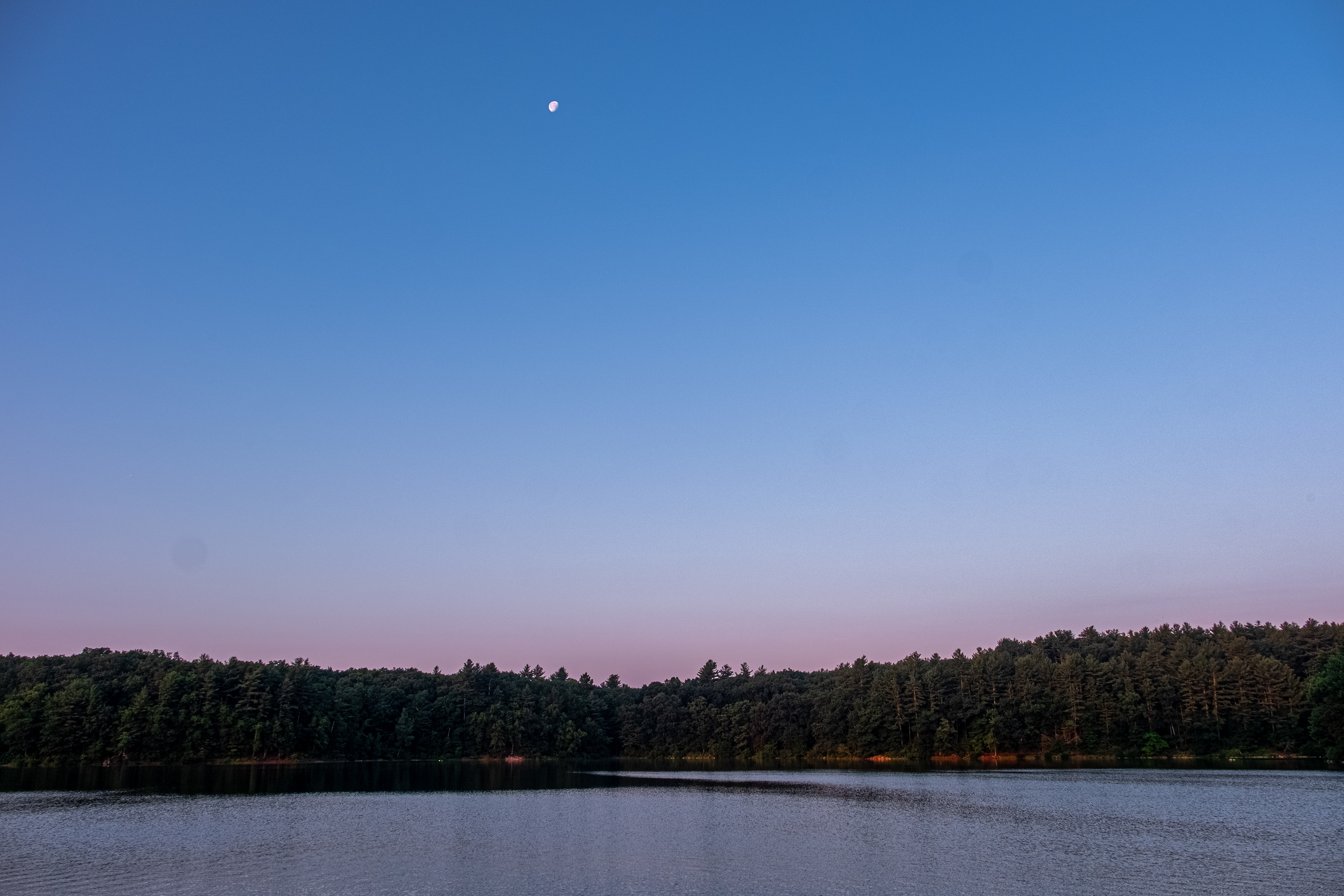
Slowly the sun displaces the moon over Walden Pond, July 2023.
Dawn over the glassy pond was indeed a sight to behold, but sadly for me, any ghostly mists present that morning must have already stealthily withdrawn.

The rosy light of dawn reveals the pond’s glassy interior.
Even so, I certainly experienced an aura. The pond is today a very popular public swimming beach, and later in the day upon seeing hundreds of swimmers, running and yelling children, kayakers on the lake, public toilets, and so forth, I felt that this was a desecration of the site. That feeling–that the site is sacred, that it must be viewed and used with reverence–surely is partly an experience of its aura. (On further thought, the idea that the pond Thoreau immortalized is now enjoyed as a natural environment by tens of thousands of visitors a year might have appealed to him, who in Walden speaks unpossessively of the pond when it has many visitors who fish and swim in it, and who invite themselves into his cabin, and in one case even take his copy of Homer).
In fact, I went a step further and kayaked and swam in Walden Pond myself. A trivial manifestation of the aura was my need to post my experience on social media (I kayaked Walden!!). But much of the time I spent on the kayak was more contemplative. Just as when you see a film made about a book you’ve previously read, and the movie’s images and actors quietly replace the mental images that you so laboriously constructed as a reader, which fade even if you try to retain them, so actually paddling on and viewing Walden Pond scattered the wispy images I had carried with me since I first read selections from Walden in high school in the 1980s. I experienced that scattering as a very personal loss; meanwhile, a native loon paddled by.
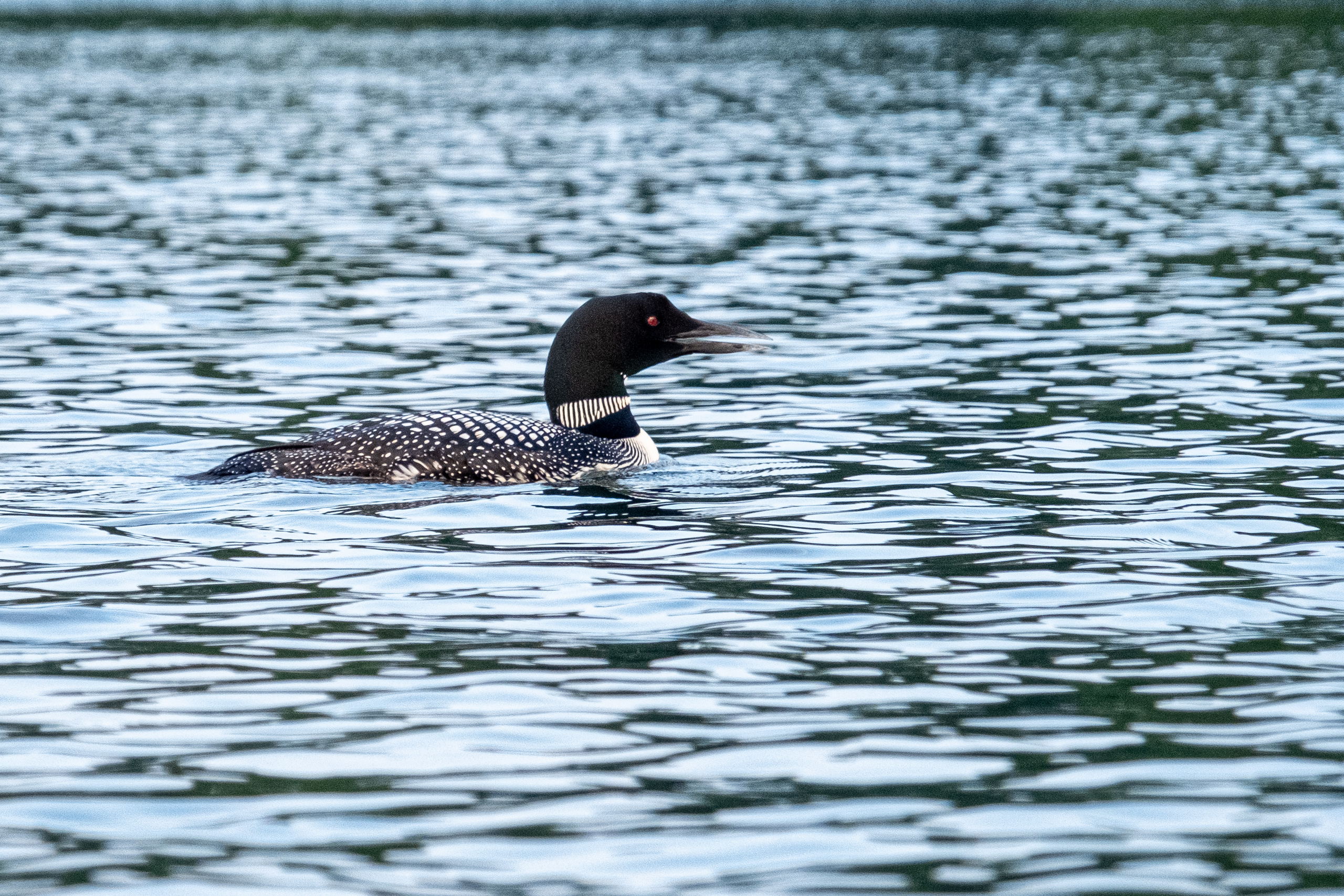
A loon paddles by.
Another unexpected experience of aura was discovering that Walden Pond is two miles away from the site of “the shot heard round the world” (i.e., the beginning of the American Revolutionary War and, at least in the American telling of the story, the beginning of the founding of democracy itself), Paul Revere’s ride, and the house where Emerson and Hawthorne both lived. Somehow the proximity to such key locations to American history gave Walden a specifically American, even patriotic, resonance it lacked when I was reading it before the trip. (Philosopher Stanley Cavell observes that Thoreau was writing at a time when Americans were eager to establish their own literature, and he even calls Walden our first national epic–I read Cavell after the trip and I think it only resonated because of the American revolutionary and literary “auras” on and around Walden Pond.)
Might the possibilities of natural places having auras help design as it reinvents itself to confront, rather than contribute to, climate crisis? Surely yes: it is hardly a coincidence that of the many little nearby lakes that Walden Pond became a state park and got so much use. Likewise we are drawn to the very trees that John Muir described, the mountains that Anselm Adams photographed, and so on.
6.
What I can’t help but notice, though, is that Walden Pond has an aura because it is profoundly, even constitutively, associated with a certain subject. Here I specifically do not mean Thoreau, the towering literary and historical figure of American culture.
Rather, I mean the odd individual who carried his furniture out of his house so that he could scrub his floors with the white sands of the pond, who could distinguish between the vocalizations of screech-owls and hooting owls and express their differences using Dantean imagery, who provides an account of the daily activities of minks, muskrats, and sparrows, and of johnswort and sand-cherry, while developing (and living!) an American philosophy that somehow is uniquely his own and also paradigmatically American. That subject–his perceptions, observations, habits–has brought Walden Pond to life for millions of readers in a way that the pond itself could not.
What that means is that the challenge is not only to create (or to preserve) places, but to design subjects to experience and sustain those places.
Thoreau’s proto-posthuman subject integrates several qualities that we can observe, and I believe that designers (and design researchers) might benefit from positioning themselves to experience being this kind of subject themselves, and/or to craft experiences of it for others.
The subject is constituted by the co-presence of each of the following:
- Keen and even scientific observation of the natural world, including its measures, behaviors, and causes. For this subject, nature is no abstraction, but the whole of the living world made available to sustained, curious, and serious inquiry.
- A strongly literary sensibility, which treats “the noblest recorded thoughts of man” as a repertoire to illuminate for us, and to help us to connect to, the natural world; and in so doing elevating us to our most perceptive, intelligent selves.
- A dialectical tension between the cultivation of the self as an entirely unique individual (one who “hears a different drummer”) and a politically engaged citizen, who sympathetically understands and also pushes his neighbors and even his nation.
- Excellently expressive of the self in words and in actions. Self-expression via words aspires toward a literary stature, while yet remaining true to the self (i.e., there is neither pretension nor performance). Self-expressive actions entail authentically being in, and being part of, the world.
When reading Walden, which is at once a journal, a work of naturalistic prose, an epic poem, and a spreadsheet, distinctions between human and nature, and between science and literature, are impossible to sustain. The text relentlessly confounds them. Instead, it fashions for us, and invites us put on and try out for ourselves, a subject for whom the nature-human synthesis creates both knowledge and beauty.
Acknowledgment
I gratefully acknowledge the insights of my collaborator on this project, Maliheh Ghajargar.
 Interaction Culture
Permalink
Loons are rare species to be seen even by experienced birders. Congratulations on spotting a loon so close! (I believe its a Common Loon, although loons are never common)